English History – Page 12 – General History

English History

Home/English History

The real Macbeth

The Scottish island of Iona, where the real Macbeth is buried / southernhebrides.com

The Scottish island of Iona, where the real Macbeth is buried / southernhebrides.com

Macbeth is the shortest of Shakespeare’s plays and probably the work most associated with that playwright’s well-known sense of imagery. His vivid imagination is also shown hard at work. Hardly a detail in the play’s structure is historically correct, but as in the same writer’s Richard III it really does not matter as the play’s the thing, and though both works might have been composed by a sixteenth century Hollywood scriptwriter, they are towering monuments to the power of the imagination. (more…)

General Templer & the Malayan Emergency

Sir Gerald Templer / sahr.co.uk

Sir Gerald Templer / sahr.co.uk

Gerald Templer, a boy destined for military honours if ever there was one, was born in 1898. After joining up as a boy soldier he rose rapidly through the ranks to become a Field Marshal. He was a fighting soldier as opposed to a headquarters mapman, and commanded the 6th Armoured Division in World War II.

He was vice-chief of what used to be called the Imperial General Staff when there was still an Empire needing a general staff, and then he was made High Commissioner in Malaya (1952 – 54) during the high moments of the Malayan Emergency. (more…)

The sea battle of Trafalgar

Artist's impression of part of the Battle of Trafalgar / britishbattles.com

Artist’s impression of part of the Battle of Trafalgar / britishbattles.com

There is a running fight, not unlike the battle of Trafalgar itself, between Spanish, British and French historians, which has continued without pause since 1805. Friendships which should have been for life have been broken because of this eminently historical conflict on the high seas. I prefer to examine the views of American historians, who should have no axe to grind, as 1805 happened a long time before US influence dominated, or at least tried to dominate the world. (more…)

The end of the British Empire and imperialism

The_British_Empire


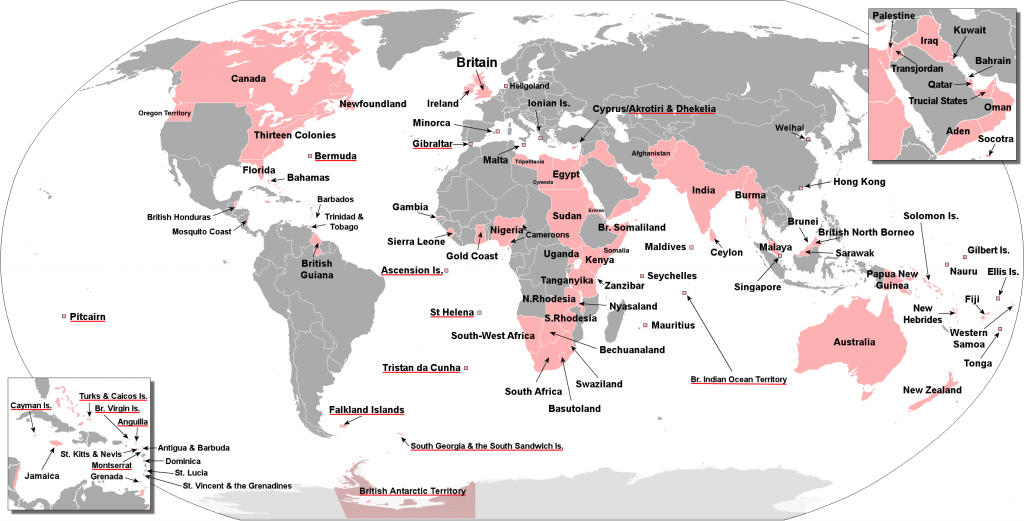
It is barely seventy-two years since a quarter of the human race lived, toiled, danced and finally died under the Union Jack. It is a very short time in terms of the history of the world, but in that time the British view of themselves, and their nation’s place in that world has altered, perhaps more radically than ever before. No other country has experienced a sudden and dramatic convulsion in its own outlook – no, not even terrible wars, occupation, subjection beneath the heel of an aggressive foreign invader, however awesome their effect, can produce a change in national philosophy as total as that undergone by the British since 1939. While Rome took centuries to crumble, the British Empire vanished almost overnight. (more…)

Reginald Pole (easy dates 1500 – 1558)

Reginald Pole / blogdelpadrefortea.blogspot.com

Reginald Pole / blogdelpadrefortea.blogspot.com

Please note that this important character from history had the plain surname of Pole. His name is not De la Pole – quite a different family*. Our subject became a Cardinal and later Archbishop of Canterbury, but through his mother (the Countess of Salisbury) he had a Yorkist claim to the throne of England. Being an intelligent man, he did not press this claim, or even mention it, though it must have passed through his mind on certain occasions. (more…)

By | 2012-12-07T11:11:32+00:00 December 7th, 2012|English History, World History|0 Comments

Two Dukes of Burgundy: Philip the Bold & Philip the Good

Our first Duke of Burgundy was born in 1342, a son of John ‘the Good’. There were so many dukes of this region of France that the theory that each earned a nickname because it was thus easier to identify each one is probably right. As a youth he fought at Poictiers against the English, was captured along with his father, and ransomed. (more…)

By | 2012-12-03T10:05:59+00:00 December 3rd, 2012|English History, French History, World History|0 Comments

Georgia (West Asia) & Georgia (USA)

Asian Georgia is separated from Russia by the Caucasus Mountains. It has a coast on the Black Sea, shares a border with Turkey to the west, and has boundaries with Azerbaijan and Armenia to the east and south. All these proximities have affected Georgia in one way or the other (usually the other) throughout her history. (more…)

Who were the Anglo-Saxons?

Anglo-Saxon men / fashion.era.com

Anglo-Saxon men / fashion.era.com

They were Jutes, a Germanic tribe whose names are preserved today in Jutland and Juteborg. They invaded Britain in the 5th century under the leadership of Hengist and Horsa. The Venerable Bede tells us they occupied the Isle of Wight, parts of the Hampshire coast, and Kent with its capital at Canterbury. They were also Saxons,  (Germanic) though they came from the Danish peninsula, and lived partly from piracy from the 3rd century AD to the 5th, when they invaded Britain at the end of Roman supremacy. Their name survives in Wessex, Essex, Sussex and Saxony in Germany itself. The Saxons and Jutes were joined by the Angles,  Germanic in origin who probably came from the area of Schleswig-Holstein or neighbouring Denmark. They settled down in East Anglia and Northumbria. Their name survives in the gradual metamorphosis from Anglo-Saxon England to Englaland and thence to England. (more…)

Six wives for Henry VIII

An unusual impression of the great monster when still young, playing (royal) tennis / flickriver.com

An unusual impression of the great monster when still young, playing (royal) tennis / flickriver.com

“History!” snorted an ex-pupil of mine the other day, “nothing but kings and dates!” I am not even sure if History is still taught in British schools of the present day.  Most children one meets know nothing at all about Britain’s past, good or bad. They might recognise a few of the names – Alfred (‘wasn’t he a Viking?’), Budicca or Boadicea (‘she had scythes on her chariot’s wheels isn’t it?’), Nelson (‘he won at Waterloo!’), Wellington ‘the French shot him at Trafsomething?’) etc. etc. Ministers of Education ensure that English is taught so that pupils mispronounce the words and cannot write them. (more…)

Orange and Orléans

Young William of Orange, future William III of England / journal.carlottamanaigo.com

Young William of Orange, future William III of England / journal.carlottamanaigo.com

When James II made his Catholicism too ostentatious for seventeenth century Protestant politicians to stomach, a successful conspiracy was made to remove him from the throne he had inherited from his brother Charles II.  Among the conspirators was John Duke of Marlborough, who had been raised to the dizzy heights he attained from being a country squire. Most of the raising had been done by James II. Do not put your faith in country squires who rise to become Dukes and have colossal palaces (Blenheim) built for them by ‘a grateful nation’. The conspirators then invited a Dutchman to come to Britain and become William III, which he did, albeit with some reluctance. He was a firm Protestant descending from Mary Queen of Scots, a Stewart, and was married to another Mary, Mary of England. This was considered a good enough claim by the conspirators, and so the Dutchman became King of England,Scotland and Ireland. Silly weak James went without much pushing into exile, where he stayed. (more…)

Load More Posts