
The Spanish conquest of the Inca Empire is often remembered as one of the most extraordinary military victories in history. In 1532, Francisco Pizarro arrived in the Andes with a remarkably small force and managed to capture Atahualpa, the ruler of one of the largest empires in the Americas. But there was another side to this story. The Inca Empire was already deeply divided by a brutal civil war. Without that internal conflict, would Pizarro ever have succeeded?
An empire divided before the Spanish arrived
When Francisco Pizarro began his expedition into Inca territory, he was not confronting an empire enjoying political stability. Just a few years earlier, the Inca state had been shaken by a succession crisis that developed into a devastating civil war.
The conflict followed the death of Huayna Cápac, one of the most powerful Inca rulers. His death, possibly during an epidemic that reached the Andes before Pizarro’s arrival, created uncertainty over the succession. His sons Huáscar and Atahualpa eventually became rivals for control of the empire.
Huáscar established his power around Cusco, the traditional political and religious centre of the Incas. Atahualpa, meanwhile, built his military strength in the northern territories, particularly around Quito. What followed was more than a personal dispute between two brothers. It was a struggle involving powerful military commanders, regional elites and different centres of political influence.
The war devastated the empire. Armies marched across its territories, populations suffered, and important political figures were killed or displaced. By the time Pizarro reached the Andes, Atahualpa had defeated Huáscar and was consolidating his position, but the consequences of the conflict were far from over. The Spanish had arrived at a particularly vulnerable moment.
The capture of Atahualpa: a victory made possible by circumstances
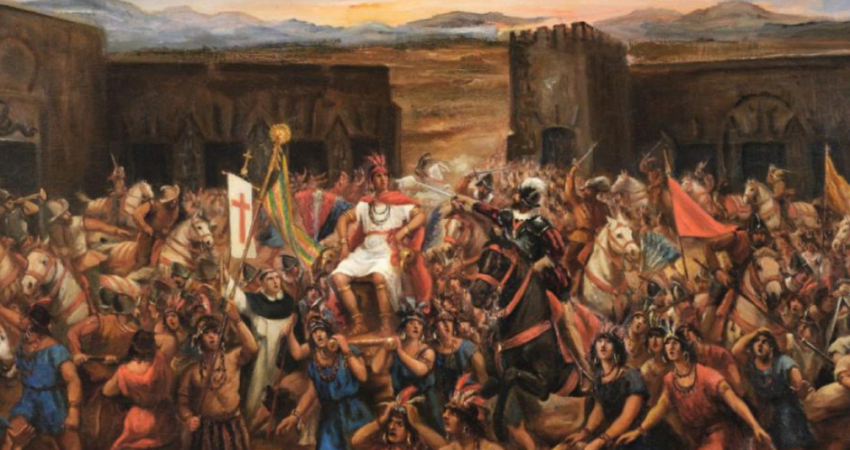
In November 1532, Pizarro and his men reached Cajamarca, where Atahualpa was staying with a large entourage. The Spaniards had only a small number of soldiers compared with the enormous population and military resources of the Inca Empire. Nevertheless, they managed to arrange a meeting with the emperor.
The encounter ended in an ambush. Spanish forces attacked the largely unarmed gathering, using horses, firearms and steel weapons to create confusion and panic. Atahualpa was captured and became a prisoner of Pizarro.
The capture was an extraordinary political and psychological shock. The Inca ruler was not simply another military commander. He occupied a central position in the political and religious organisation of the empire. Pizarro understood that controlling the emperor could provide leverage over the wider Inca state.
Atahualpa offered an enormous ransom of gold and silver in exchange for his freedom. The Spanish accepted the treasure but eventually executed him in 1533. However, capturing the emperor was not the same as conquering the entire empire. The Spanish still needed indigenous allies, local political cooperation and military force to extend their authority.
The civil war had weakened more than the Inca army
It is tempting to assume that the civil war simply reduced the number of soldiers available to defend the empire. In reality, its consequences were much more complicated.
The Inca Empire, known as Tawantinsuyu, was an enormous political system held together through military authority, administrative organisation, religious legitimacy and relationships with local rulers. Its expansion had brought numerous communities under Inca control. Some had accepted imperial authority, while others had resisted it or maintained their own political ambitions.
The civil war exposed these underlying tensions. Atahualpa’s victory did not automatically restore unity. Many territories had recently supported Huáscar, and their local elites now had to decide whether to accept the victorious ruler, resist him or seek new opportunities.
This created a political environment in which Pizarro could find potential allies. Rather than confronting a completely united empire, the Spanish encountered a society in which loyalties had been disrupted and political relationships were being reconsidered.
What if the civil war had never happened?
This is where the historical question becomes particularly interesting. Imagine that Huayna Cápac had died but the succession had been settled peacefully. Atahualpa and Huáscar might have avoided a destructive conflict, allowing the imperial administration and military leadership to remain more cohesive.
When Pizarro arrived, he would potentially have faced a very different situation. An empire with an undisputed ruler, loyal regional governors and experienced military commanders would have been considerably more difficult to manipulate.
There are several reasons why this could have changed the outcome.
1. A united military command
The Inca military system was capable of organising large armies and moving troops across considerable distances. Without the civil war, the empire might have retained a more experienced and politically reliable military leadership. Pizarro’s small force would have faced a greater risk of being intercepted before reaching Cajamarca.
A coordinated military response could have prevented the Spanish from approaching the emperor under such favourable circumstances. Even if the Spaniards had managed to enter Inca territory, they might have encountered a much more organised defence.
2. Fewer opportunities for indigenous alliances
The Spanish depended heavily on relationships with indigenous groups. Political divisions created opportunities to recruit allies who had their own reasons for opposing the Inca authorities.
Without the succession conflict, some of these alliances might have been harder to establish. Communities that had supported Huáscar or suffered during the civil war might have had fewer reasons to cooperate with foreign invaders.
However, it is important to remember that resistance to Inca authority existed before the civil war. Not all indigenous opposition was caused by the succession struggle, and a politically united empire would not necessarily have eliminated local rivalries.
3. Greater political legitimacy
A ruler whose succession was widely recognised could have commanded greater loyalty from regional elites. This would not necessarily have eliminated local resistance, but it might have reduced the number of political openings available to Pizarro.
The capture of Atahualpa was particularly damaging because it removed a recently victorious ruler at a moment when the empire was still recovering from internal conflict. A more established and widely accepted sovereign might have been harder to isolate politically.
4. A different response to the Spanish presence
A politically stable Inca government might have treated the Spanish expedition as a military threat much earlier. Instead of allowing Pizarro to approach Cajamarca and arrange a meeting with Atahualpa, imperial authorities might have monitored or confronted the expedition before it reached the emperor.
These are plausible counterfactual scenarios, not events that can be established from historical evidence. Nevertheless, they demonstrate how much the timing of Pizarro’s arrival may have influenced the outcome.
Was the civil war really the main reason Pizarro succeeded?
There is an important distinction between weakening an empire and making its conquest possible. The civil war was undoubtedly a major factor, but it was not the only explanation.
Pizarro’s expedition benefited from several advantages that existed independently of the conflict between Huáscar and Atahualpa. The Spanish possessed steel weapons, firearms, horses and military experience gained during earlier campaigns. These advantages were particularly effective during surprise attacks and encounters in confined spaces.
The capture of Atahualpa at Cajamarca also demonstrated the importance of deception, timing and the ability to exploit an unexpected political encounter. However, European military technology alone cannot explain the Spanish victory.
The Spaniards were vastly outnumbered, and their survival depended on indigenous cooperation. Their ability to negotiate with local authorities, establish alliances and exploit political rivalries was essential. The conquest was not simply a contest between Spanish soldiers and Inca warriors; it involved numerous indigenous communities with their own political interests and objectives.
The political turmoil following Huayna Cápac’s death provided Pizarro with opportunities to establish Spanish power through alliances and political manipulation, rather than simply through military superiority.
The conquest did not end with Atahualpa’s capture
Another common misconception is that the capture of Atahualpa immediately destroyed the Inca Empire. In reality, the Spanish still needed to establish control over the imperial territories.
After Atahualpa’s execution in 1533, Pizarro supported Manco Inca, a member of the royal family, as the new Inca ruler. Initially, this arrangement helped the Spaniards gain political legitimacy and cooperation. But the relationship eventually collapsed.
In 1536, Manco Inca launched a major rebellion against Spanish authority, laying siege to Cusco with a large indigenous army. Although the rebellion failed to eliminate Spanish control, Manco escaped and established an independent Inca resistance centre in Vilcabamba.
His successors continued resisting the Spanish for decades. The final ruler of this Neo-Inca state, Túpac Amaru I, was captured and executed in 1572. This long period of resistance demonstrates that the Spanish conquest was neither immediate nor inevitable.
The survival of the Inca resistance also raises an interesting question: if the empire had entered the Spanish invasion without the destruction caused by the civil war, could it have maintained its independence for much longer?
Could a united Inca Empire have defeated Pizarro?
The most reasonable answer is that it could have made his expedition considerably more difficult, but we cannot know whether it would have prevented the conquest altogether.
A united empire would probably have been better positioned to organise its military response, protect its political leadership and prevent the Spanish from exploiting internal rivalries. Nevertheless, political unity would not have eliminated the Spanish advantages in weaponry, cavalry, military tactics and the ability to form alliances with indigenous opponents of Inca rule.
There is also an important consideration: the Spanish conquest was not the work of Pizarro and his original expedition alone. It involved subsequent reinforcements, new Spanish settlers and thousands of indigenous allies. Even if Pizarro had failed in 1532, another Spanish expedition might eventually have attempted to establish control over the Andes.
The outcome could have been different, perhaps dramatically so, without necessarily preventing European colonisation. A united Inca Empire might have resisted longer, negotiated from a stronger position or forced the Spanish to pursue a very different strategy.
Conclusion: The Inca Civil War may have changed the course of American history
The Spanish conquest of the Inca Empire cannot be explained simply by superior European weapons or the military genius of Francisco Pizarro. The civil war between Huáscar and Atahualpa created political divisions, weakened relationships between the imperial centre and provincial elites, and provided the Spanish with opportunities that might not otherwise have existed.
Pizarro did not encounter a united empire prepared to confront an external invasion. He arrived during a period of political transformation, exploited the situation and used the capture of Atahualpa to gain influence over the wider political system.
Would the Incas have survived if the civil war had never happened? Perhaps. At the very least, the Spanish would have faced a considerably more complicated challenge.
The most important lesson is that the fall of the Inca Empire was not simply a story of Europeans defeating an indigenous civilisation. It was also a story of internal political conflict, competing ambitions and the extraordinary consequences of an external power exploiting divisions within an existing empire.
Historical sources and further reading
- R. Alan Covey, The Fall of the Inca Empire (2023).
- John H. Rowe, The Inca Civil War and the Establishment of Spanish Power in Peru (2006).
- R. Alan Covey, Inca Apocalypse: The Spanish Conquest and the Transformation of the Andean World (2020).
- Robert McCaa, Aleta Nimlos and Teodoro Hampe Martínez, Why Blame Smallpox? The Death of the Inca Huayna Capac and the Demographic Destruction of Tawantinsuyu.
Historical note: The precise cause of Huayna Cápac’s death remains uncertain. Smallpox is frequently proposed, but the surviving documentary evidence is not conclusive.