English History – Page 26 – General History

English History

Home/English History

The White Rajah of Sarawak

In a recent article, I published a brief account of the rise and fall of the British empire. The empire was just as much a product of private enterprise and individual initiative as it was a result of British and foreign politics. British adventurers discovered the lands and islands that eventually formed the empire, British politicans secured their ‘new ownership’, and British administrators managed the vast possessions, while the British Navy sailed round the world protecting them. James Brooke is a perfect example. Young, ambitious, ruthless, slight in build but wide in intellect, Brooke arrived in Borneo as just another administrator. He immediately set about helping one of the Brunei princes to put down a revolt, organised what ships of the fleet he could find to seek out pirates (of which there were thousands) and destroy them, and found himself rewarded with the governorship of Kuch in 1841 before he was forty.
(more…)

By | 2025-05-20T21:05:25+00:00 October 31st, 2010|Asian History, English History|11 Comments

The American Civil War

The American Civil War

By Dean Swift

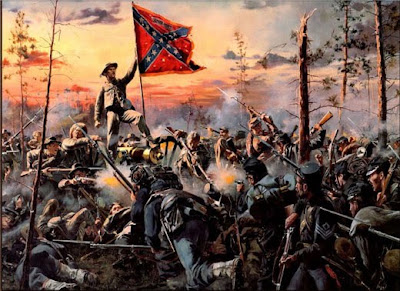
Like all civil wars, none of which are the least civil, the American Civil War was a murderous and bloody conflict between brothers, fathers and sons, uncles and nephews and cousins. In other words, it was fratricidal. It lasted four years, and had to take place basically because eleven Southern states wished to leave the Union. The war was fought between the United States’ federal government and the Confederate States of America.

The conflict started on April 12th, 1861. After a bombardment mostly without casualties, Federal leader Robert Anderson surrended Fort Sumter in the harbour mouth of Charleston, South Carolina. His garrison consisted of around 85 soldiers. He had been besieged by around 5,500 Confederate troops under Beauregard.

(more…)

By | 2025-05-20T21:04:06+00:00 October 31st, 2010|English History, US History, World History|6 Comments

Jack The Ripper and the British Royal Family

The name describes the pseudonymous murderer of at least seven women, all of them prostitutes, in or near the poor district of Whitechapel in London from August 7 to November 10, 1888. The identity of Jack the Ripper has never been truly established, though many candidates have been put forward by eminent writers, criminologists and cranks. Many novelised versions have been written and published. Many film stories have been made and distributed – some with notable success.

All but one of the Ripper’s victims were killed while ‘on business’ in the streets. The police and the judicial authorities call this ‘soliciting’, or ‘soliciting for immoral purposes’. In each instance, the victim’s throat was cut, and the body mutilated in such a way that officials recognised that the murderer had a good knowledge of human anatomy.

(more…)

By | 2010-10-31T10:12:58+00:00 October 31st, 2010|English History, World History|3 Comments

The British Empire

What we mean by this expression was (formerly) an apparently haphazard collection of lands throughout the world linked by common allegiance to the British throne. In 1800, though Britain had lost her Thirteen Colonies in North America, she still retained Newfoundland, scarcely populated parts of Canada and many West Indian islands, plus other islands useful for trading purposes. Britain held Gibraltar from Spain following the Treaty of Utrecht which ended the War of the Spanish Succession. In 1788 she had created convict settlements in New South Wales, Australia, which greatly helped the condition of overcrowding in prisons at home.

(more…)

The orchestrated Suez Canal Affair (1956)

Suez is a ship canal joining the Mediterranean Sea (at Port Said) with the Red Sea (at the Gulf of Suez). It was built to provide a sea route from Europe to Asia that did not involve having to sail all the way round Africa. It was built by French engineer Ferdinand de Lesseps between 1859 and 1869. It is unusual for a canal in that it has no locks, as the two sea levels are almost the same.

The British bought holding shares in the canal in 1875, and the entire Canal Zone was held as a British base from 1882 to 1955. Egypt nationalized the canal company in 1956, which started the Suez War and briefly closed the canal. It was closed again from 1967 to 1975 after the Six-Day and Yom Kippur Wars.

(more…)

By | 2025-05-20T21:02:33+00:00 October 31st, 2010|African History, Asian History, English History, World History|0 Comments

Imperialism

Called by some ‘colonialism’ – a mistake – imperialism is a term frequently abused by being used pejoratively by politicians and journalists. For historians, the word can be applied to numerous epochs, in each of which there may be detected a shade of difference, always significant.

Persia, Macedonia, Ottoman Turkey, Spain, France, Soviet Russia and Britain have extended their respective domain over other societies at different times, giving way to imperial rule. Germany has attempted to rule over others, using force. Britain used commercial enterprise backed by a powerful navy. Spain used a powerful navy backed by the immense courage of the conquistadores. Persia used vast resources and her armies, while Alexander’s Macedonia used the outstanding personality and popularity of its leader to create an empire.

(more…)

England: The fall and rise of Socialism

England’s Labour Party has elected the new party leader, Ed Miliband. This unsurprising event was described in this column in our last edition. It must have been a good choice, because the opinion polls held since the leadership contest show that Labourites have been distinctly encouraged by Ed’s push to the top.

It would be difficult to describe the politics of the last two Labour prime ministers. Tony Blair showed disdain for typical socialist dogma, and was probably more to the right than Margaret Thatcher or especially John Major. Gordon Brown (who was never elected by the people) should have been a true blooded socialist, as the relatively poor son of the manse, but wasn’t.

(more…)

By | 2010-10-21T22:05:08+00:00 October 21st, 2010|English History|0 Comments

All American Presidents

Early United States history may be conveniently studied by reference to the 32 Presidents of the period 1789 – 1945:
(I) George Washington, Federalist 1789 – 97; (II) John Adams, Federalist 1797 – 1801; (III) Thomas Jefferson. Republican Democrat 1801 – 9; (iv) James Madison, Republican Democrat 1809 – 17; (v) James Monroe, Republican Democrat 1817 – 25; (vi) John Quincy Adams, Republican Democrat 1825 – 9; (vii) Andrew Jackson, Democrat 1829 – 37; (viii) Martin van Buren, Democrat 1837 – 41; (ix) William Harrison, Whig 1841; (x) John Tyler, Whig Democrat 1841 – 5; (xi) James Polk, Democrat 1845 – 9; (more…)

By | 2025-05-20T21:01:44+00:00 October 21st, 2010|English History, US History, World History|5 Comments

The Congress of Vienna (1814/15)

This international assembly could be said to have established the system of diplomacy that lasted throughout the 19th century, and a long way beyond. It set out to settle the affairs of Europe after the defeat of Napoleon, whom when it began was supposedly safely locked up on the island of Elba. Despite the Emperor’s escape and subsequent attempt at European domination – again – the Congress continued during the Hundred Days (March – to June, 1815) that led to Waterloo. After Bonaparte had been taken to St. Helena (where he died) the whole of Europe could, for the first time in thirty-five years, breathe freely again.

(more…)

The abdication of Edward VIII (1936)

The crisis arose from the expressed desire of King Edward VIII of England to marry a twice-divorced American woman. While his father George V was ill, struggling through the last years of a longish reign, the Prince of Wales (Edward) had enjoyed a series of affairs with married women. Queen Mary thought this was a youthful phase that her son would grow out of, but Elizabeth, the very young wife of Edward’s younger brother Bertie Duke of York thought otherwise.

Precedent suggested rather forcefully that it was in the spirit of the (unwritten) British Constitution for the sovereign to seek the advice of Ministers before marriage. In order to marry a divorced and foreign woman, a special sanction would have require passing by the British Parliament, and the governing bodies of all the Dominions.

(more…)

By | 2025-05-20T21:01:33+00:00 October 21st, 2010|English History|0 Comments
Load More Posts