US History – Page 20 – General History

US History

Home/US History

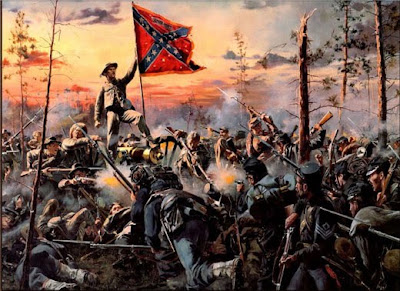
The American Civil War
The American Civil War

By Dean Swift

Like all civil wars, none of which are the least civil, the American Civil War was a murderous and bloody conflict between brothers, fathers and sons, uncles and nephews and cousins. In other words, it was fratricidal. It lasted four years, and had to take place basically because eleven Southern states wished to leave the Union. The war was fought between the United States’ federal government and the Confederate States of America.

The conflict started on April 12th, 1861. After a bombardment mostly without casualties, Federal leader Robert Anderson surrended Fort Sumter in the harbour mouth of Charleston, South Carolina. His garrison consisted of around 85 soldiers. He had been besieged by around 5,500 Confederate troops under Beauregard.

(more…)

By | 2025-05-20T21:04:06+00:00 October 31st, 2010|English History, US History, World History|6 Comments

The American Revolution

1776 – 1783:  American colonists revolt and declare independence

One of the more obvious oddities about the American War of Independence is that it need not have happened. By no means all citizens established in the thirteen Colonies desired or craved for independence from Britain. If the eventual leaders of the War had listened to some of their colleagues instead of beating the drum, things might have been quite different.

(more…)

By | 2025-05-20T21:04:47+00:00 October 31st, 2010|US History|1 Comment

The British Empire

What we mean by this expression was (formerly) an apparently haphazard collection of lands throughout the world linked by common allegiance to the British throne. In 1800, though Britain had lost her Thirteen Colonies in North America, she still retained Newfoundland, scarcely populated parts of Canada and many West Indian islands, plus other islands useful for trading purposes. Britain held Gibraltar from Spain following the Treaty of Utrecht which ended the War of the Spanish Succession. In 1788 she had created convict settlements in New South Wales, Australia, which greatly helped the condition of overcrowding in prisons at home.

(more…)

Imperialism

Called by some ‘colonialism’ – a mistake – imperialism is a term frequently abused by being used pejoratively by politicians and journalists. For historians, the word can be applied to numerous epochs, in each of which there may be detected a shade of difference, always significant.

Persia, Macedonia, Ottoman Turkey, Spain, France, Soviet Russia and Britain have extended their respective domain over other societies at different times, giving way to imperial rule. Germany has attempted to rule over others, using force. Britain used commercial enterprise backed by a powerful navy. Spain used a powerful navy backed by the immense courage of the conquistadores. Persia used vast resources and her armies, while Alexander’s Macedonia used the outstanding personality and popularity of its leader to create an empire.

(more…)

All American Presidents

Early United States history may be conveniently studied by reference to the 32 Presidents of the period 1789 – 1945:
(I) George Washington, Federalist 1789 – 97; (II) John Adams, Federalist 1797 – 1801; (III) Thomas Jefferson. Republican Democrat 1801 – 9; (iv) James Madison, Republican Democrat 1809 – 17; (v) James Monroe, Republican Democrat 1817 – 25; (vi) John Quincy Adams, Republican Democrat 1825 – 9; (vii) Andrew Jackson, Democrat 1829 – 37; (viii) Martin van Buren, Democrat 1837 – 41; (ix) William Harrison, Whig 1841; (x) John Tyler, Whig Democrat 1841 – 5; (xi) James Polk, Democrat 1845 – 9; (more…)

By | 2025-05-20T21:01:44+00:00 October 21st, 2010|English History, US History, World History|5 Comments

The Congress of Vienna (1814/15)

This international assembly could be said to have established the system of diplomacy that lasted throughout the 19th century, and a long way beyond. It set out to settle the affairs of Europe after the defeat of Napoleon, whom when it began was supposedly safely locked up on the island of Elba. Despite the Emperor’s escape and subsequent attempt at European domination – again – the Congress continued during the Hundred Days (March – to June, 1815) that led to Waterloo. After Bonaparte had been taken to St. Helena (where he died) the whole of Europe could, for the first time in thirty-five years, breathe freely again.

(more…)

Treaty of Versailles: Facts, Causes and Effects


One of the chief contributing causes of the Second World War was the Treaty of Versailles (June, 1919), that officially ended the First World War. Its main terms were surrender of ALL German colonies in Africa and the Far East, which would be mandated to Britain, France, Belgium, South Africa, Japan and Australia. This led to a re-distribution under a series of mandates – for example, the return of Alsace-Lorraine to France, the cession of Eupen-Malmedy to Belgium; plebiscites to be held in Northern Schleswig, the cession of Prussian Poland, parts of East Prussia and Upper Silesia to Poland; (more…)

By | 2025-05-20T21:01:16+00:00 October 18th, 2010|English History, Spanish History, US History, World History|23 Comments
Load More Posts