Dean Swift – Page 45 – General History

admin

Home/Dean Swift

About Dean Swift

‘Dean Swift’ is a pen name: the author has been a soldier; he has worked in sales, TV, the making of films, as a teacher of English and history and a journalist. He is married with three grown-up children. They live in Spain.

The second Spanish Republic


Manuel Azaña / biografiasyvidas.com

Manuel Azaña / biografiasyvidas.com

  Political philosophies in the Latin country of Spain are so aggressive that journalists who have an opinion, or dare to have an opinion about politics that affect Spain run the risk of, at the least, being spat upon in the street. At the most, they might be killed, as happened to a number of writers and journalists during the 1930s. Victims were usually affiliated to the Left, but many who died were of the Right. We are going to attempt to write an unbiased account of the Spanish Second Republic which lasted from 1931 to 1936; we are not associated with, nor affiliated with any political party. Nor do we consider ourselves right-wing or left-wing. An American TV crime series used to have its chief character saying “Just give us the facts . . .” in every episode. That is what we intend to do in this post.

Spain’s first democratic administration for nearly sixty years was established in 1931 and was cheered by the population, following fairly disastrous policies of the monarchy. But the Republic had to face an almost indefatigable series of obstructions, such as the unmovable and institutional power of ‘the ruling classes’, the timidity and feebleness of the State, immeasurable debt and the international impact of the Depression and, above all, radical differences in the regime’s own ranks. (more…)

By | 2013-03-19T11:57:37+00:00 March 19th, 2013|Church history, Spanish History, World History|0 Comments

A brief history of spectator sports


Le Mans 1955: Pierre Levegh lies near his crashed car that killed over 80 spectators /documentingreality.com

Le Mans 1955: Pierre Levegh lies near his crashed car that killed over 80 spectators /documentingreality.com

Most (but not all) of the sports which are super-popular with the public today were invented, improved and regulated in the independent private schools of Victorian Britain; that is to say, what in England are still called ‘the public schools’, as opposed to state ones. The most popular of all – Soccer – was being played in early medieval England, and has always been an almost entirely working-class game. (more…)

The Seven Years War


  Most of the eighteenth century featured wars in Europe, as rulers came and went and tried to dominate other rulers. Nearly always the same countries were involved, and the Seven Years War was no exception: Prussia, Britain and Hanover (then a separate state) ranged up against Austria, France, Sweden, Spain and you guessed it – Russia. The date was 1756. (more…)

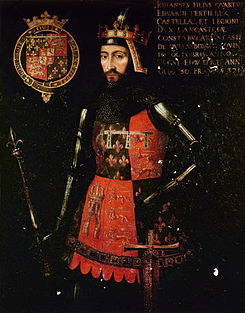
John of Gaunt

John of Gaunt

John of Gaunt – Duke of Lancaster

The man who would be king – though not of England

John of Gaunt, Duke of Lancaster was a son of an English king. He was the father of an Englishman who was also a father and grandfather of English kings. Through his third and last wife he even engendered the first of the Tudors, for which haters of this dynasty cannot forgive him. But Gaunt never wished to be king of England, though he fought most of his life to be king of Castilla – in Spain.

He was the third surviving son (and actual fourth son) of Edward III (q.v.) and his queen, Philippa of Hainault; born at Ghent in 1340 – his birthplace supplies his name. He was tall, athletically built, appropriately gaunt of visage, clever and ambitious. His father Edward married him to Blanche, daughter and heiress of Henry, Earl and Duke of Lancaster, who was richer than the king. When Henry, who had served the monarchy dutifully died in 1362, John became Duke of Lancaster. He also became very rich indeed because of the marriage laws of that period. (more…)

The time when there were THREE Popes

   At this very moment the cardinals gathered in the Vatican are arguing about who shall be the next Pope, following Benedict XVI’s resignation on grounds of health. While the octogenarian Ratzinger rests ( and he certainly deserves to) in Castelgandolfo, dozens of seniors of the Catholic Church will shortly approach the moment when they must vote for the new Pontiff, and we will see white (or possibly) black smoke puffing from the famous chimney, installed again only two days ago. But many Catholic co-religionists do not even know that at the time of the Great Schism in the fourteenth century, there were at one time three popes! (more…)

The curse of the ‘Devil’s Horsemen’

Ghengis, the dreaded Khan / taringa.net

Ghengis, the dreaded Khan / taringa.net

It is said that in the early part of the thirteenth century, English fish dealers working on the long eastern coast at places like Grimsby and Yarmouth were in a sad state of near-bankruptcy because their regular customers from the Baltic Sea and Russia had ceased to call with their fish. The populace had to make do with herrings, which came from the North Sea and in abundance. But what had happened to the Russian fishermen? (more…)

By | 2013-03-08T11:43:45+00:00 March 8th, 2013|Asian History, History of China|0 Comments

Edward I: devious, eloquent, wily, courageous, untrustworthy – great


Edward I of England, known as 'Longshanks' / shakespeareandhistory.com

Edward I of England, known as ‘Longshanks’ / shakespeareandhistory.com

A contemporary historian who knew him said Edward I of England was very tall, with long neck, arms and legs, and gave him the nickname ‘Longshanks’. It is certain that he was an excellent horseman, and expert with a sword or axe. He looked sinister, as his left eyelid drooped, but his councillors learned quickly to listen very carefully to the king, who was prone to fits of typically Plantagenet bad temper. He threw his daughter Elizabeth’s coronet into a blazing fire in one of these fits, and in another he actually threw one of his errant son Edward’s male lovers out of a tower window. (more…)

By | 2013-03-06T12:12:51+00:00 March 6th, 2013|British History, English History|0 Comments

Frederick II (‘Stupor Mundi’)

To avoid confusion, one remembers that there were two Frederick IIs, Frederick ‘The Great’, an eighteenth century monarch, and our subject in this article, Frederick ‘Stupor Mundi’ a title given him by his courtiers, meaning ‘wonder of the world’.

He was born in 1194, son of Henry VI King of ‘Germany’ (Germany was divided into kingdoms, principalities, dukedoms, archdukedoms and palatinates) and a mother whose background was Sicilian. His grandfather was Frederick I, known as ‘Barbarossa’. (more…)

The first European Community (failed)

Edward III / fanpop.cpm

Edward III / fanpop.cpm

The EEC as we know it today bears no resemblance to this first attempt, but at least enough initiative was shown by its inventors to make it last for a few years, changing the name occasionally. The basic idea is sound, but the firm proposition thought up by the German and the French is now out of control, divided into Commissions, Committees, Parliament, Court of Justice etc. which lead of course to chaos and desperate over-spending.

In 1337 Edward III of England sent a special group to what was then called the Low Countries. The group’s aim was to make friends with the Counts of Flanders and Hainault, along with many other European princes of the blood, in order to be prepared for yet another impending war with France, but Edward’s diplomatic strategy (he preferred battles) was only faintly discernible. In fact the embassy was a disaster, humiliating Edward before his own courtiers as well as his enemies, and leaving him with a near-bankrupt England. The King was semi-reluctantly drawn into his favourite strategy – war. He was very good at that. A lot of wars then took place, which rescued him from his worst mistake in a long reign. (more…)

Load More Posts