World History – Page 28 – General History

World History

Home/World History

The Radical Republican Party (PPR) of Spain


Alexandro Lerroux (es.wikipedia.org

Alexandro Lerroux (es.wikipedia.org

  Since they were given the chance to do so, the Spanish people have preferred to vote for left-inclined political parties. After the new Constitution of 1978, signed by all parties three years after the death of Franco, there have been thirteen years of PSOE rule under Felipe González, and nearly eight years of the same party in power with Zapatero as titular head. The Popular Party, founded by conservative Manuel Fraga and others, is not conservative or right-wing at all. It is a pure Social Democratic Party under another name. So is the Spanish Workers’ Socialist Party (PSOE): the two principal parties are social democrats but cannot learn to live or work together. (more…)

By | 2013-03-29T10:33:13+00:00 March 29th, 2013|Spanish History, World History|0 Comments

Popular Myths and the Conspiracy Theory: ‘the stab in the back’ 1918


Friedrich Ebert did not believe in the Allies' victory / en.wikipedia.org

Friedrich Ebert did not believe in the Allies’ victory / en.wikipedia.org

Learnéd, and sometime not so learnéd people have started myths right down through the centuries almost since the human race was ‘uncivilized’. King Alfred ‘burning the cakes’, ‘Robin Hood and Maid Marian’, Richard III ‘murdering his nephews’, changelings occupying thrones in Europe, what lay behind the sinking of the Titanic, foreknowledge of Pearl Harbor, was the Russian royal family killed in a cellar in Siberia? Plus a long line of etceteras. (more…)

Metternich

Prince Metternich painted by Laurence / en.wikipedia.org

Prince Metternich painted by Laurence / en.wikipedia.org

Of all the great statesmen and diplomats whose many different names have managed to confuse so many history students in the last century or two, this one is perhaps the most important, because of the significance of what he achieved before he finally failed. We have dealt with most of them in this general-history blog – John of Gaunt, Cardinal Richelieu,  Thomas Cromwell, von Bismarck, both William Pitts, Palmerston, Gladstone, Disraeli – the list is long indeed. (more…)

The battle of Blood River ( Natal, 1838)


The battle at Blood River / sahistory.org.za

The battle at Blood River / sahistory.org.za

The ‘Great Trek’ was the massed movement of Boer (Dutch/Africans) farmers to the north out of the Cape Colony into the Orange Free State, Natal and Transvaal in the 1830s. The Boers had resented the British ever since the end of the Napoleonic Wars, when they took over the Cape from the Dutch settlers. They disliked new laws which prevented them from buying or keeping slaves, and they equally disliked what they saw as soft treatment of black people in the courts. Therefore trekboers wanted not only to get away from British rule but also to find more land – and new sources of labour; several thousand people migrated northwards across the Orange River and into lands still controlled by blacks. (more…)

The Kaiser (Wilhelm II of Germany)


All in the family; Wilhelm II with, among other, George V and Alfonso XIII. All pictured here are cousins

All in the family; Wilhelm II with, among other, George V and Alfonso XIII. All pictured here are cousins and descendents of Queen Victoria

The future King of Prussia and German Emperor was born in 1859, the eldest son of the then Crown Prince Frederick of Prussia (he later became Emperor Frederick III) and his wife,  daughter and namesake of Queen Victoria of Great Britain and Empress of India. This made George V, against whom Wilhelm went to war his first cousin – an embarrassment to say the least. He was born with a semi-paralysed left arm, several inches shorter than the right one. (more…)

The second Spanish Republic


Manuel Azaña / biografiasyvidas.com

Manuel Azaña / biografiasyvidas.com

  Political philosophies in the Latin country of Spain are so aggressive that journalists who have an opinion, or dare to have an opinion about politics that affect Spain run the risk of, at the least, being spat upon in the street. At the most, they might be killed, as happened to a number of writers and journalists during the 1930s. Victims were usually affiliated to the Left, but many who died were of the Right. We are going to attempt to write an unbiased account of the Spanish Second Republic which lasted from 1931 to 1936; we are not associated with, nor affiliated with any political party. Nor do we consider ourselves right-wing or left-wing. An American TV crime series used to have its chief character saying “Just give us the facts . . .” in every episode. That is what we intend to do in this post.

Spain’s first democratic administration for nearly sixty years was established in 1931 and was cheered by the population, following fairly disastrous policies of the monarchy. But the Republic had to face an almost indefatigable series of obstructions, such as the unmovable and institutional power of ‘the ruling classes’, the timidity and feebleness of the State, immeasurable debt and the international impact of the Depression and, above all, radical differences in the regime’s own ranks. (more…)

By | 2013-03-19T11:57:37+00:00 March 19th, 2013|Church history, Spanish History, World History|0 Comments

A brief history of spectator sports


Le Mans 1955: Pierre Levegh lies near his crashed car that killed over 80 spectators /documentingreality.com

Le Mans 1955: Pierre Levegh lies near his crashed car that killed over 80 spectators /documentingreality.com

Most (but not all) of the sports which are super-popular with the public today were invented, improved and regulated in the independent private schools of Victorian Britain; that is to say, what in England are still called ‘the public schools’, as opposed to state ones. The most popular of all – Soccer – was being played in early medieval England, and has always been an almost entirely working-class game. (more…)

The Seven Years War


  Most of the eighteenth century featured wars in Europe, as rulers came and went and tried to dominate other rulers. Nearly always the same countries were involved, and the Seven Years War was no exception: Prussia, Britain and Hanover (then a separate state) ranged up against Austria, France, Sweden, Spain and you guessed it – Russia. The date was 1756. (more…)

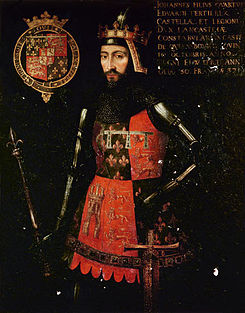
John of Gaunt

John of Gaunt

John of Gaunt – Duke of Lancaster

The man who would be king – though not of England

John of Gaunt, Duke of Lancaster was a son of an English king. He was the father of an Englishman who was also a father and grandfather of English kings. Through his third and last wife he even engendered the first of the Tudors, for which haters of this dynasty cannot forgive him. But Gaunt never wished to be king of England, though he fought most of his life to be king of Castilla – in Spain.

He was the third surviving son (and actual fourth son) of Edward III (q.v.) and his queen, Philippa of Hainault; born at Ghent in 1340 – his birthplace supplies his name. He was tall, athletically built, appropriately gaunt of visage, clever and ambitious. His father Edward married him to Blanche, daughter and heiress of Henry, Earl and Duke of Lancaster, who was richer than the king. When Henry, who had served the monarchy dutifully died in 1362, John became Duke of Lancaster. He also became very rich indeed because of the marriage laws of that period. (more…)

Load More Posts