Dean Swift – Page 24 – General History

admin

Home/Dean Swift

About Dean Swift

‘Dean Swift’ is a pen name: the author has been a soldier; he has worked in sales, TV, the making of films, as a teacher of English and history and a journalist. He is married with three grown-up children. They live in Spain.

Ireland’s neutrality during World War II

Eamon de Valera / es.wikipedia.org

Eamon de Valera / es.wikipedia.org

Ireland’s neutrality in World War II

As the clouds of war deepened over Europe in 1939, certain countries declared their neutrality in the hope that they would not become involved in what promised to be a world conflict. Turkey (both the Axis powers and the 1939 allies tried to lure her into the net), Switzerland (right in the middle of what might be a European killing ground, with her own big citizen army and easily defended terrain), Portugal, teetering towards Fascist Germany but which seemed, at the time to be pro-Allies), the Vatican, inscrutable, but probably anti-Nazi, Sweden which pronounced her neutrality while permitting sales of her iron ore deposits to Germany and allowed Germany the right to move troops over her borders: Spain, whose Caudillo was in debt to Hitler recently given in the Spanish Civil War. There was not much love lost between Hitler and Franco however; they were to meet at Hendaye for a nine-hour conference in October 1940: later Hitler said that he would prefer a long visit to the dentist than another meeting with the Generalissimo. (more…)

By | 2014-04-02T08:39:18+00:00 April 2nd, 2014|World History|0 Comments

The Sykes-Picot Agreement

Sir Mark Sykes / syrianhistory.com

Sir Mark Sykes / syrianhistory.com

The Sykes-Picot Agreement (‘Honesty in diplomacy is rare’)

In 1916 a secret agreement was signed between Britain and France, each country agreeing to take control of Turkey in the form of newly – made partitions. War was coming and the Ottoman Empire (q.v.) was inclined to join the Central Powers (q.v.).  Britain would directly control the Baghdad /Basra region of southern Iraq, while France would have the north Syrian coast. In the rest of Mesopotamia and the interior of Syria, France would have indirect control in the north, and Britain in the south. Palestine, apart from a coastal section which would go to Britain would come under international governance.

But this was by no means all: Russia, in return for recognising the agreement, would receive  part of Eastern Anatolia. The Agreement was therefore in conflict, morally at least, with the Husayn/McMahon correspondence, which had promised independence to Arabs in most areas. Russia, Bolshevik after the October Revolution (q.v.), nastily published the text of the Sykes/Picot lash-up, greatly embarrassing both France and Britain. The Arabs were convinced after this that Britain, in particular, was engaged in double-dealing, and insincere when making promises. In the Great War the actions of Laurence of Arabia in the Arab interest served to change the Arab view, and it is likely that Allenby’s successes could not have occurred if Laurence had not convinced the Arabs that not all British diplomats spoke with a forked tongue.


By | 2014-04-01T10:03:20+00:00 April 1st, 2014|History|1 Comment

Old posts to create our First Book

Winston Churchill

Winston Churchill is happy for us

Dear Sirs,

We must apologize for having removed all previous posts. This is the third time that we have suffered an attack from robots or spammers and even Google was starting to look down on us. Therefore the admin of this page has decided to erase all content and start again from scratch in order to solve all previous problems.

We did this knowing that we have many saved copies of all previous articles, at present being compiled in order to create a real book. The General-History Book, ideal for History Students, will be available for sale on Amazon.co.uk.  Even Winston Churchill is happy for us up there, somewhere. . .

Best wishes from Dean Swift

By | 2014-03-31T16:18:45+00:00 March 31st, 2014|History|2 Comments

Who said it . . .?

This is another of those brief quizzes designed to keep your mind active. Please tell me who said these things in the form of a Comment. The last ‘Who said it?’ was masterfully won by David Williams on 7th March, 2014. The answer is W.C. Fields. Now think about these:

 “Why should people go out and pay to see bad movies when they can stay at home and see bad television for nothing?”

“Any man who goes to see a psychiatrist should have his head examined.”

“Pictures are for entertainment; messages should be delivered by Western Union.”

“That’s the way with these directors, they’re always biting the hand that lays the golden egg.’

“A verbal contract isn’t worth the paper it is written on.”

“Gentlemen, include me out!” (while resigning from something).

“I’ll tell you in two words – im possible.”

“We can always get more Indians off the reservoir.”

“We’ve all passed a lot of water since those days.”

“Elevate those guns a little lower!”

Field Marshal Montgomery visited America and our subject entertained him at an exclusive dinner party. When everyone was seated our subject beat time against a glass and announced,“Ladies and gentlemen, I propose a toast to Marshall Field Montgomery . . .”Another personality, seated nearby, cracked “Montgomery Ward, you mean . . .”

When one of his studio (CLUE) employees told our subject he was off to the Second World War as a volunteer, he said, “I’ll cable Hitler and tell him to shoot around you.”


By | 2014-03-19T09:11:28+00:00 March 19th, 2014|World History|1 Comment

The ‘Indian’ Wars

The indian wars

The indian wars

Images, dreamlike or real, and the reputation of the Native American have greatly altered in the last forty or fifty years; he was always the treacherous and deadly villain of the Hollywood scene until certain directors began to take a more sympathetic view. Nowadays the painted ‘savage’ is likely to be an all-American hero rather than a killing machine. Political correctness has changed his name from ‘Red Indian’ to Native American, and Heaven help the writer or speaker who says otherwise. White frontiersmen disliked them strongly: Kit Carson, a frontiersman if ever there was one, said, “I wouldn’t trust any of them,” and Jim Bridger spoke of the ‘wicked and mean Sioux”. Jim Baker the Mountain Man snarled, “they are the most onsartenest (sic) varmints in creation . . . tha’r not moren half human . . . tain’t no use talking of honour with them . . .” etc. Doubtless some of ‘them varmints’ would have held the same opinion about Baker. (more…)

By | 2014-04-01T15:09:10+00:00 March 17th, 2014|US History|0 Comments

The Homestead Act & Strike

This Act was passed in the US government in 1862, at the very height of the ‘Wild West’ era – brave pioneers heading west, ‘Redskins’ whose land it was biting the dust, shootists biting the dust, rumours of massive amounts of gold to be found by prospectors and so on. The intention of the Act was to encourage people in the East to settle anew in the West. Any citizen over 21, or head of a family would be allotted a property of 160 acres – to be his after five years occupation and work. In the following 38 years the government awarded more than 600,000 lucky claimants 80 million acres of mostly arable land. There were hitches however; many claimants were not farmers, they were land speculators, and farmers knew that 160 acres would make too small a farm to make it worth leaving the East and heading for the Great Plains. In fact, a better way to open up the vast ‘virgin’ lands was for individual states and the railroads to prospective settlers. The railroads had already received 520 million acres from the federal government. Perversely, railroads needed settlers to pay to ride on their trains, so they sold off much of the land they got from the government! (more…)

By | 2014-04-01T15:09:54+00:00 March 14th, 2014|A History of North America, US History|0 Comments

The Great Depression

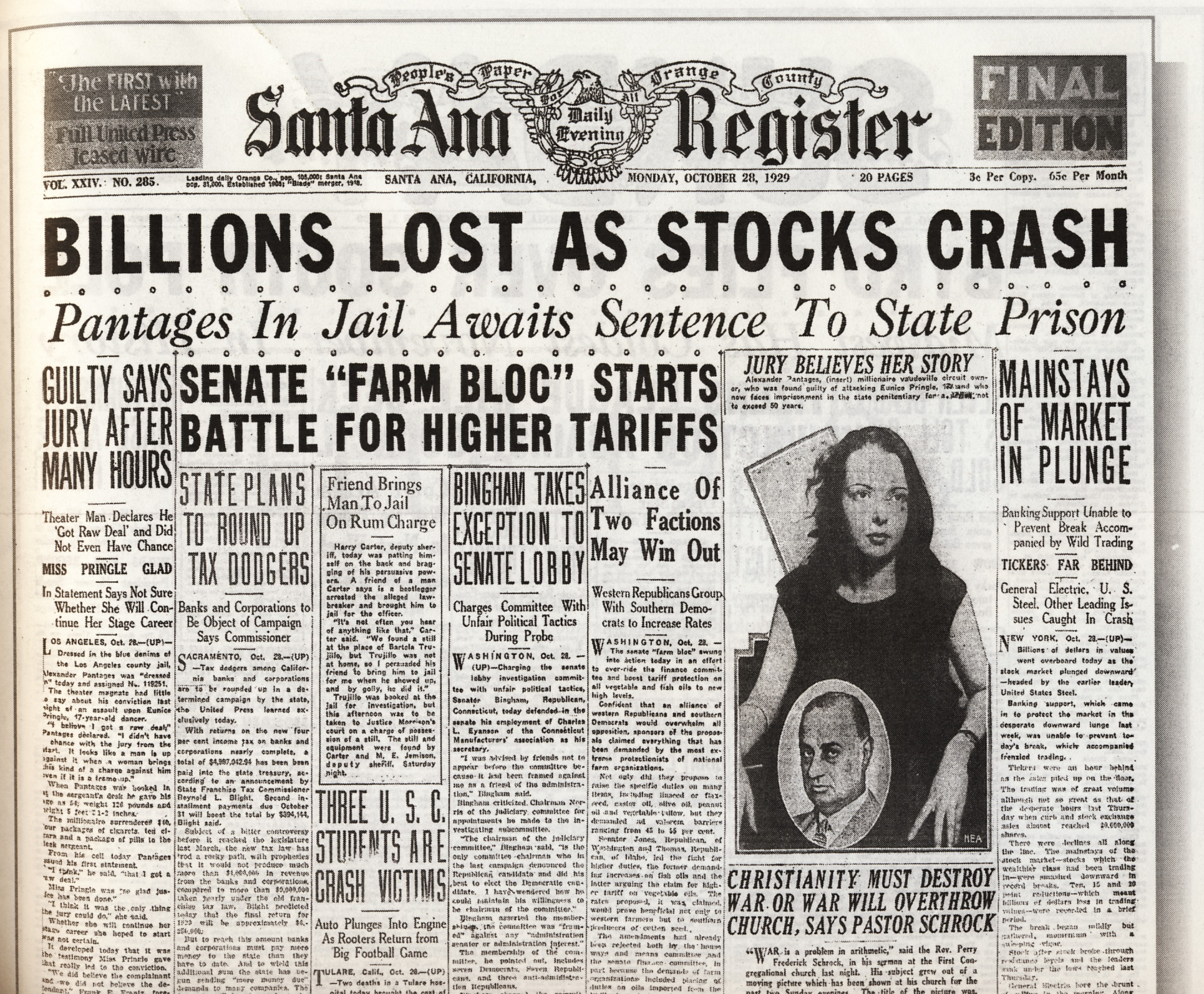
This ten-year horror followed the Wall Street Crash (q.v. 2 days ago), lasting from 1929 to 1939, and might have been longer had not World War 2 interrupted the economic wizards who created it. Since their dramatic and tardy entrance in the last year of the Great War, the United States of America had become the dominant nation on this planet, especially in the world economy. No-one is quite sure whether successive US presidents wanted, like Britain, a huge empire and very little money, or a huge amount of money and no empire. Whatever, the collapse of share prices indicated a rapid withdrawal of loans to other countries, tariffs were raised so that imports declined, and agricultural prices sank.

Most rural districts could not possibly buy industrial goods, which meant the closure of factories and shops going bankrupt. Unemployment shot up, and mean streets were littered with bums who might weeks before have been brokers. From 1929 to 1932 unemployment in Britain and Belgium rose to 33%, in Germany 44% and the US 27%; popular hoodlums like Bonnie and Clyde grew rich dangerously. (more…)

By | 2014-04-01T15:10:52+00:00 March 13th, 2014|US History, World History|0 Comments

The Wall Street Crash

Since the end of the immediate post-War depression in US financial markets, occurring in 1922, share prices rose dramatically. Naturally this encouraged a speculative boom and by 1929 the financial history of the US had never been more hay-wire. Nearly ten million investors, many  hardly knowing where Wall Street was, bought shares not for income but to sell for a quick profit. Not only that, but they bought without paying cash, using ‘credit’ or ‘on margin’. It was bound to head for disaster. (more…)

By | 2014-04-01T15:11:38+00:00 March 12th, 2014|US History, World History|0 Comments

Dwight D. Eisenhower

Dwight D. Eisenhower was born in 1890, of Dutch-American stock. He became a general and the 34th President of the United States. He saw war in a quite different way than another American officer, George Patton (q.v.): ‘I hate war,’ he often said, ‘as only a soldier who has lived it can, only as one who has seen its brutality, its futility, its stupidity.’ (more…)

Gustav V of Sweden

Gustav V of Sweden lived from 1858 to 1950, and reigned from 1907, which makes him the longest reigning king in Swedish history. He was a shy man, naturally reserved, disliking any kind of pomp and ceremony, ably demonstrating this trait by refusing a coronation ceremony. This questionable act gave him another ‘first’ – that of being an uncrowned monarch.

Notwithstanding, Gustav asserted the personal power of the monarchy; he challenged the Liberal Party’s government in 1914 with a demand for greater spending on defence. He did this in what became known as ‘The Courtyard Speech’, actually addressing a gathering of local farmers. (more…)

By | 2014-04-01T15:13:22+00:00 March 9th, 2014|German History, Scandinavian history|0 Comments
Load More Posts