British History – Page 16 – General History

British History

Home/British History

The Virginius incident


Artist's impression of the sinking of the Virginius / historyofcuba.com

Artist’s impression of the sinking of the Virginius / historyofcuba.com

By the last quarter of the nineteenth century piracy and slavery/the slave trade were almost extinguished, partly because governments were not inclined, as they had before, to ‘turn a blind eye’. The slave trade had been abolished in the British West Indies in 1834, and in North America in 1863. Both US warships and the British Navy were kept busy maintaining the Law. While the sixteen and seventeenth centuries had seen ‘gentleman adventurers’ running their own buccaneering ships backed by European kings and governments in the ‘licenced piracy’ industry, the ‘Jolly Roger’ was now frowned upon, especially by Britain and the United States, while superb Dutch, French and Spanish navigators based on the Venezuelan and Brazilian coasts and in the Caribbean were still loath to give up a highly profitable (though risky) business. In the South China Sea there has always been piracy, though half-crazy individuals like Brooke the White Rajah of Sarawak (q.v.) did much to suppress it. (more…)

The beginnings of the Dominion of Canada


The original inhabitants of the Dominion - the Iroquois /cynthia swope.com

The original inhabitants of the Dominion – the Iroquois /cynthia swope.com

Canada is the second largest country in the world, even if large masses of it are covered in ice. We all know that the cultivated or potentially arable parts of this vast territory were fought over following discovery by the French and the English and other races from Europe who had braved the Atlantic Ocean to start a new life in the New World. But first the world needed to know about the legal and political geography of Canada. (more…)

The (disastrous) Peace of Amiens


PM George Canning painted by R. Evans /es.wikipedia.org

PM George Canning painted by R. Evans /es.wikipedia.org

The months of February and March, 1802 encouraged a fairly peaceful interlude in the Napoleonic Wars between France and (principally) Britain. The British people were sick to death of war and its concomitant high taxation. In March the results of divisive talks produced the Treaty of Amiens, a nonsense by which nearly all Britain’s overseas conquests were to be handed back. These included the sugar-rich islands of Martinique and Guadeloupe; Tobago to Spain (France’s ally) and the entire Cape of Good Hope to the Dutch. Britain was also ordered to give up the strategically important island of Malta, Britain’s sole base in the Eastern Mediterranean. (more…)

The Roman emperor who died in Britain

Septimius Severus, died at York / heritagedaily.com

Septimius Severus, died at York / heritagedaily.com

A few of you clever bloggers will deny it, but it is a fair bet that nobody knew that a Roman emperor died in Britain. Everybody knows that Hadrian, Julius Caesar and even Co-Clo-Claudius visited Britain, but Lucius Septimius Severus Pertinax, a.k.a. Septimius Severus (146 – 211 AD) breathed his last there. (more…)

By | 2013-03-29T12:12:17+00:00 March 29th, 2013|British History, History of Rome, World History|0 Comments

Popular Myths and the Conspiracy Theory: ‘the stab in the back’ 1918


Friedrich Ebert did not believe in the Allies' victory / en.wikipedia.org

Friedrich Ebert did not believe in the Allies’ victory / en.wikipedia.org

Learnéd, and sometime not so learnéd people have started myths right down through the centuries almost since the human race was ‘uncivilized’. King Alfred ‘burning the cakes’, ‘Robin Hood and Maid Marian’, Richard III ‘murdering his nephews’, changelings occupying thrones in Europe, what lay behind the sinking of the Titanic, foreknowledge of Pearl Harbor, was the Russian royal family killed in a cellar in Siberia? Plus a long line of etceteras. (more…)

The battle of Blood River ( Natal, 1838)


The battle at Blood River / sahistory.org.za

The battle at Blood River / sahistory.org.za

The ‘Great Trek’ was the massed movement of Boer (Dutch/Africans) farmers to the north out of the Cape Colony into the Orange Free State, Natal and Transvaal in the 1830s. The Boers had resented the British ever since the end of the Napoleonic Wars, when they took over the Cape from the Dutch settlers. They disliked new laws which prevented them from buying or keeping slaves, and they equally disliked what they saw as soft treatment of black people in the courts. Therefore trekboers wanted not only to get away from British rule but also to find more land – and new sources of labour; several thousand people migrated northwards across the Orange River and into lands still controlled by blacks. (more…)

The Kaiser (Wilhelm II of Germany)


All in the family; Wilhelm II with, among other, George V and Alfonso XIII. All pictured here are cousins

All in the family; Wilhelm II with, among other, George V and Alfonso XIII. All pictured here are cousins and descendents of Queen Victoria

The future King of Prussia and German Emperor was born in 1859, the eldest son of the then Crown Prince Frederick of Prussia (he later became Emperor Frederick III) and his wife,  daughter and namesake of Queen Victoria of Great Britain and Empress of India. This made George V, against whom Wilhelm went to war his first cousin – an embarrassment to say the least. He was born with a semi-paralysed left arm, several inches shorter than the right one. (more…)

A brief history of spectator sports


Le Mans 1955: Pierre Levegh lies near his crashed car that killed over 80 spectators /documentingreality.com

Le Mans 1955: Pierre Levegh lies near his crashed car that killed over 80 spectators /documentingreality.com

Most (but not all) of the sports which are super-popular with the public today were invented, improved and regulated in the independent private schools of Victorian Britain; that is to say, what in England are still called ‘the public schools’, as opposed to state ones. The most popular of all – Soccer – was being played in early medieval England, and has always been an almost entirely working-class game. (more…)

The Seven Years War


  Most of the eighteenth century featured wars in Europe, as rulers came and went and tried to dominate other rulers. Nearly always the same countries were involved, and the Seven Years War was no exception: Prussia, Britain and Hanover (then a separate state) ranged up against Austria, France, Sweden, Spain and you guessed it – Russia. The date was 1756. (more…)

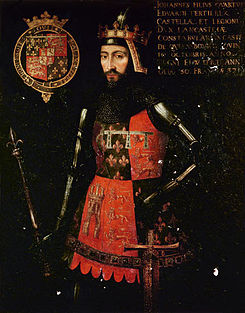
John of Gaunt

John of Gaunt

John of Gaunt – Duke of Lancaster

The man who would be king – though not of England

John of Gaunt, Duke of Lancaster was a son of an English king. He was the father of an Englishman who was also a father and grandfather of English kings. Through his third and last wife he even engendered the first of the Tudors, for which haters of this dynasty cannot forgive him. But Gaunt never wished to be king of England, though he fought most of his life to be king of Castilla – in Spain.

He was the third surviving son (and actual fourth son) of Edward III (q.v.) and his queen, Philippa of Hainault; born at Ghent in 1340 – his birthplace supplies his name. He was tall, athletically built, appropriately gaunt of visage, clever and ambitious. His father Edward married him to Blanche, daughter and heiress of Henry, Earl and Duke of Lancaster, who was richer than the king. When Henry, who had served the monarchy dutifully died in 1362, John became Duke of Lancaster. He also became very rich indeed because of the marriage laws of that period. (more…)

Load More Posts