British History – Page 19 – General History

British History

Home/British History

All-time mysteries: Roanoke Island & the Marie Celeste

Roanake: what happened to the settlers? / sonofthesouth.net

Roanake: what happened to the settlers? / sonofthesouth.net

In Albemarle Sound off the northern coast of North Carolina there is an island which was the first English colony in North America. This is Roanoke, where a small group of settlers financed by Sir Walter Raleigh had tried to establish themselves in 1585. The local natives had had other ideas, and the beleaguered settlers were ‘rescued’ by Francis Drake, who had been engaged in  one of his buccaneering expeditions in the Caribbean. (more…)

Serfs

As villeins or servants of a medieval lord serfs were not actually slaves, though many writers of historical novels would have them so. Peasants they were, and by no means free. They were there to work the land of the lord (from which comes the more modern expression ‘landlord’). Serfs represented the lowest possible level of society. (more…)

Dr. Beeching & the British railways (1960s)

Dr. Beeching: not even Hitler could have done so much to change the face of Britain / mirror.co.uk

Dr. Beeching: not even Hitler could have done so much to change the face of Britain / mirror.co.uk

One of the greatest achievements of the Victorians took place in the home country, not abroad somewhere in the over-large Empire. A railway network second to none, not even the massive transcontinental railroads of the United States, sprang up linking every part of the United Kingdom. Just before the First War there were over 20,000 miles of railway in Britain.

As part of the great nationalization craze after the Second War under Clement Atlee, great names of railway companies vanished: GWR, LNER, LMS and other acronyms for rail companies were not to be heard again, though with the de-nationalisation at the end of the 20th century, old companies were revived under new names. (more…)

The real Macbeth

The Scottish island of Iona, where the real Macbeth is buried / southernhebrides.com

The Scottish island of Iona, where the real Macbeth is buried / southernhebrides.com

Macbeth is the shortest of Shakespeare’s plays and probably the work most associated with that playwright’s well-known sense of imagery. His vivid imagination is also shown hard at work. Hardly a detail in the play’s structure is historically correct, but as in the same writer’s Richard III it really does not matter as the play’s the thing, and though both works might have been composed by a sixteenth century Hollywood scriptwriter, they are towering monuments to the power of the imagination. (more…)

General Templer & the Malayan Emergency

Sir Gerald Templer / sahr.co.uk

Sir Gerald Templer / sahr.co.uk

Gerald Templer, a boy destined for military honours if ever there was one, was born in 1898. After joining up as a boy soldier he rose rapidly through the ranks to become a Field Marshal. He was a fighting soldier as opposed to a headquarters mapman, and commanded the 6th Armoured Division in World War II.

He was vice-chief of what used to be called the Imperial General Staff when there was still an Empire needing a general staff, and then he was made High Commissioner in Malaya (1952 – 54) during the high moments of the Malayan Emergency. (more…)

The sea battle of Trafalgar

Artist's impression of part of the Battle of Trafalgar / britishbattles.com

Artist’s impression of part of the Battle of Trafalgar / britishbattles.com

There is a running fight, not unlike the battle of Trafalgar itself, between Spanish, British and French historians, which has continued without pause since 1805. Friendships which should have been for life have been broken because of this eminently historical conflict on the high seas. I prefer to examine the views of American historians, who should have no axe to grind, as 1805 happened a long time before US influence dominated, or at least tried to dominate the world. (more…)

The end of the British Empire and imperialism

The_British_Empire


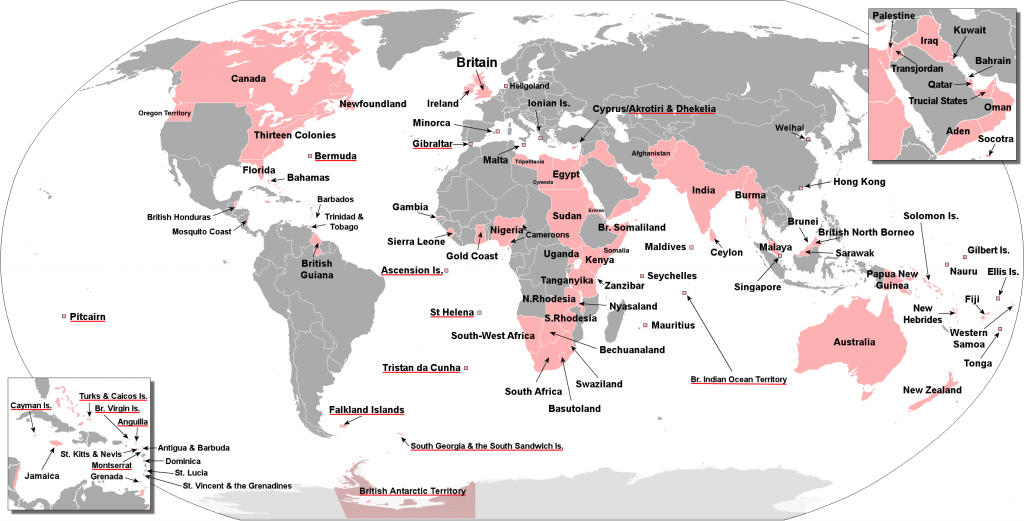
It is barely seventy-two years since a quarter of the human race lived, toiled, danced and finally died under the Union Jack. It is a very short time in terms of the history of the world, but in that time the British view of themselves, and their nation’s place in that world has altered, perhaps more radically than ever before. No other country has experienced a sudden and dramatic convulsion in its own outlook – no, not even terrible wars, occupation, subjection beneath the heel of an aggressive foreign invader, however awesome their effect, can produce a change in national philosophy as total as that undergone by the British since 1939. While Rome took centuries to crumble, the British Empire vanished almost overnight. (more…)

Georgia (West Asia) & Georgia (USA)

Asian Georgia is separated from Russia by the Caucasus Mountains. It has a coast on the Black Sea, shares a border with Turkey to the west, and has boundaries with Azerbaijan and Armenia to the east and south. All these proximities have affected Georgia in one way or the other (usually the other) throughout her history. (more…)

Antarctica

This is one of the planet’s biggest and most unknown continents. It surrounds the South Pole, and lies almost entirely to the south of latitude 66º 33’ S. This is called ‘The Antarctic Circle’.

     Travellers who have dared to enter this formidable area of the Earth have noted that the sun neither rises at midwinter nor sets at midsummer. At the South Pole itself the temperature is on average -50º C; this is because an excessively thick icecap covers the continent, forming a huge plateau. Strong winds invariably blow from the centre of the icecap, and it usually too cold to snow. The little snow that does fall takes hundreds of years to change into ice. The ice moves so grindingly slowly that parts of the icecap are millions of years old. (more…)

Another modest proposal: Gibraltar

Gibraltar: contentious since 1704

Gibraltar: contentious since 1704

The spiky old issue of Gibraltar is digging Spanish and British statesmen in the most tender part of their well-fed anatomies – what to do with Gibraltar? Ever since the signing of the Treaty of Utrecht in 1713 (very nearly three hundred years ago), the two puissant old ladies have been scratching at each other’s eyes because of Gibraltar. (more…)

Load More Posts