Dean Swift – Page 16 – General History

admin

Home/Dean Swift

About Dean Swift

‘Dean Swift’ is a pen name: the author has been a soldier; he has worked in sales, TV, the making of films, as a teacher of English and history and a journalist. He is married with three grown-up children. They live in Spain.

War in the air Part III: the Pacific

/ pacificwar.org.au

/ pacificwar.org.au

The carrier-based Japanese air force began the war in the air over the Pacific Ocean by attacking without prior warning the US naval base at Pearl Harbor. The damage to American capital ships and the loss of life were enormous, but as pointed out in another post on this site, no US aircraft carriers were present on 7 December, 1941.

   The Japanese, as industrious as ever, had made great strides in the design and construction of these floating airfields, and at Pearl Harbor they made full use of them. Four hundred bombers and fighters were launched from the six carriers used in the assault. Surprise too was an essential element, as Japan had not declared war on the United States, though everyone from the President in Washington to the Texan cowpokes knew the two countries were on a war footing, and that Japan had joined the Axis. (more…)

War in the air Part II: Per Ardua Ad Astra


A scene from the film The Battle of Britain / omfdb.org

A scene from the film The Battle of Britain / omfdb.org

  The Blizkrieg from Nazi Germany that opened the Second War in 1939 showed that apart from tank power, air power was a vital component of Hitler’s war efforts. Germany pounded the meagre defences of Poland from the air, breaking communications, causing death and chaos on a scale not known by the suffering Poles not even during their centuries of abuse by neighbours. Dive-bombers called Stukas were used by the Luftwaffe, and a malevolent touch was added by their fitted sirens, terrorizing populations as the bombers hurtled almost vertically down from brilliant blue skies, releasing their lethal cargo at the last moment before straightening out. Many pilots, very young and with very little experience, did not straighten out, with the result that the Stuka made a bigger hole in the earth than its bombs. The efficient and very fast Messerschmidt I09 and 110 fighters attacked the ramshackle Polish aircraft without mercy, destroying most of the aeroplanes on the ground even before the pilots could climb into them. Many of these young ill-disciplined but courageous young men escaped to England, and were to take an important part in the air Battle of Britain. Assault parachutists were dropped from heavier German aircraft – a new use of air power pioneered by the Germans and quickly copied by Germany’s enemies. Parachutists were extensively used in the attack and invasion of Crete in 1941. (more…)

War in the air: part I; the early days

Air combat / en.wikipedia.org

Air combat / en.wikipedia.org

In the very late nineteenth century hot-air balloons were first used in Europe for observing enemy troop movements. War in the air had started. Later the same balloons were used for comparatively accurate direction indication for artillery. In Woolwich, England, the British Army Balloon School was founded (in 1878) to train soldiers in this new mode of war. The balloons were soon found to be limited in manoeuvrability and the new airships or dirigibles replaced them. The Germans were particularly fast in this new development, and began arming the airships too.

   After the success of the Wright brothers in 1903, fragile wood and canvas aeroplanes powered by engines began to appear everywhere in Europe and the United States, but it was in France that the enormous potential of fighting from and in the air was first recognised. When the Great War started in 1914 aircraft were available that could fly up to 120 miles per hour – and stay in the air for up to two hours with the aid of freshly designed fuel tanks. The aeroplanes were small, and at first could take only two crew, the pilot and the observer/gunner. They were most uncomfortable, but at least the airmen could return to their airfield (if they survived war in the air) to sit in the sun and drink tea. (more…)

By | 2014-09-24T09:39:55+00:00 September 23rd, 2014|World History|0 Comments

Four illustrious Cecils

William Cecil / tudorplace.com.ar

William Cecil / tudorplace.com.ar

William Cecil was the first illustrious Cecil, men from an ordinary background who managed, by determination, hard work, guile, ambition and not a little luck to reach very near the top in English history. William worked as a young lawyer with the Dukes of Somerset and Northumberland. He was born in 1520 and was made Secretary of State at thirty. He cleverly avoided the fates of both his bosses (executed for some reason or other) and when Henry VIII’s daughter by Catherine of Aragon – Mary – became Queen he rapidly became a fair imitation of a devout Roman Catholic by conversion.

   Mary Tudor died (rather fortunate for England, for she had been Bloody) and Elizabeth her half sister, born of Anne Boleyn, became Queen. She made him her Chief Secretary of State, and for the following forty years he was her chief advisor, counsel, and loyal subject. He was also the architect of her successful reign as he kept an iron grip on the Administration, influenced the Queen’s pro-Protestant foreign policies, and got rid of the troublesome Mary Queen of Scots by getting Elizabeth to sign the essential death warrant. The Queen, as always, sat on various fences at once by using special Tudor skills of her own, and bitterly complained after the execution that William had ‘tricked her into signing’. This was the nearest that he sailed into the wind, and indeed he was banned from the Court for a while, but Elizabeth soon needed him again. Working closely with the cunning Francis Walsingham (q.v.), who ran the 16th century forerunner of the SIS, he knew all about King Philip of Spain’s intention to invade Britain, and made more than adequate preparations for the country’s defence against the Gran Armada. (more…)

By | 2014-09-22T16:12:46+00:00 September 22nd, 2014|British History, English History, Today, World History|0 Comments

NEWS of the books

General History in book format!

Don’t forget Volumes One & Two of GENERAL HISTORY

are available on Amazon wherever you may be.

These books are simply the articles posted on the website

www.general-history.com

in the form of a properly printed paperback book.

Volume Three will be published around Christmas time, 2014.

Jeremy Taylor (Dean Swift), college days! / Erik Thurston

Jeremy Taylor (Dean Swift), college days! / Erik Thurston

‘Dean Swift’ is the pen name used by author Jeremy Taylor

for his History books.

Just go to Amazon.com, or Amazon.co.uk, or Amazon.es etc.

Click on the long top rectangle ‘All’

Click on ‘Books’

Key in General History Dean Swift.

Both volumes will appear; become a subscriber to Amazon

or if you are already a subscriber, choose your mode of payment.

It is just as easy as that.

By | 2014-09-19T09:10:24+00:00 September 19th, 2014|History|0 Comments

The USSR and its leaders

/ commons.wikimedia.org

/ commons.wikimedia.org

This article deals with the former Soviet Union, a.k.a. Union of Soviet Socialist Republics. The USSR was a federation of fifteen republics, forming what was the world’s largest sovereign state from the 1920s until dissolution in 1991. To call it a ‘sovereign’ state is perhaps a misnomer, as the regime that ruled the Soviet Union was 100% Communist, having executed most of the Russian royal family in Siberia in 1918. (more…)

By | 2014-09-18T17:18:35+00:00 September 17th, 2014|Russian history, World History|0 Comments

Conversos (the converted)


Religious poet Fray Luis de León

Religious poet Fray Luis de León

Jews in the Spain of the Middle Ages, though never popular, were permitted to convert from Judaism to Christianity; rigorous tests conducted by priests followed equally stern training. The ‘converts’ were called Conversos to define the essential difference between someone born and baptized Christian and a ‘convert’. In addition, they were sometimes called ‘New Christians’ to distinguish them from Old or Non-Semitic Christians. In popular speech they were often called Marranos which is vulgar Spanish for pigs. The correct term is Cerdo, but this word is also used by the Spanish to describe any male they happen to deprecate, probably with reason. (more…)

By | 2014-09-16T09:18:53+00:00 September 16th, 2014|Church history, Jewish History, Spanish History|0 Comments

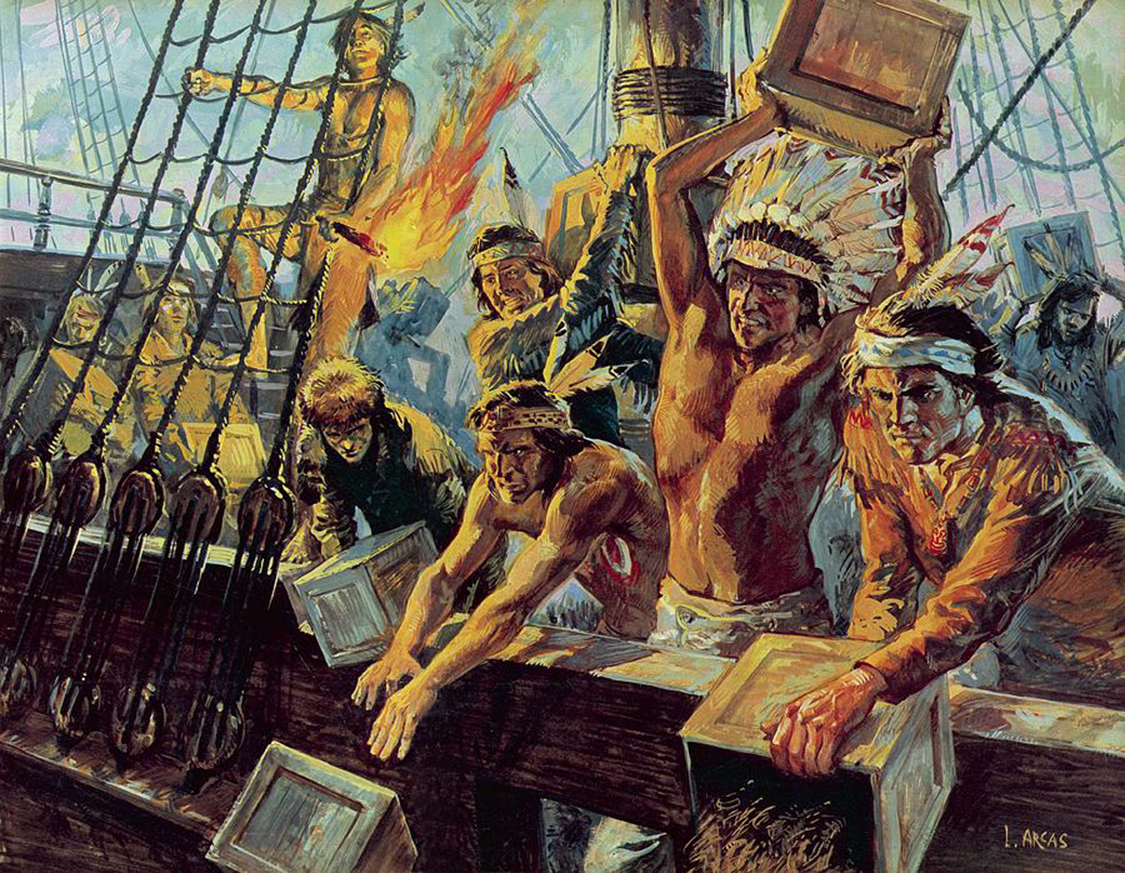
The Boston Massacre, Tea Party & the Intolerable Acts

Depiction of the Tea Party painted by Louis Arcas / down withtyranny.blogspot.com

Depiction of the Tea Party painted by Louis Arcas / down withtyranny.blogspot.com

By March, 1770 a strong sense of resentment and general feelings of unrest among American colonists, who came mainly from Britain but were intermixed with many citizens from other European states, led to violent action against British regulations and troops. On the fifth of March in that year, British troops under the command of a nervy officer were ill-disciplined enough to open heavy musket fire against a mob of revolting citizenry in the major colonial city of Boston. The fusillade killed five Bostonians, and nine British soldiers were tried for murder in a hastily gathered tribunal. As the people of Boston predicted, the result of the trial was seven acquitted (including the nervous commander), and two soldiers convicted of manslaughter. It was not good enough, and led to further trouble.

   The American Revolution (q.v.), happened because of colonists’ rage at attempts to impose direct taxation in the colonies without representation in London, in addition to a general increase of discontent with British rule within most of the thirteen colonies. In 1773, again in Boston, a ‘democratic’ group of working men mixed with larking students from colonial bourgeois families stripped off their clothes, dressed again as American natives, boarded ships in the harbour carrying (heavily taxed) tea sent from Emgland, and tipped nearly three hundred and fifty chests of the stuff into the harbour. There was little opposition. The harbour changed colour, and other North American ports disallowed entry to tea-carrying ships. With typical laconic American humour, this mild incident quickly became known as The Boston Tea Party. Recently, a new US political group has called itself ‘Tea-Party’ with an eye to history.

   Parliament in London over-reacted to the Boston Tea Party, as might be expected: In 1774 the Members decided to punish naughty Massachusetts and Boston in particular. They passed the Boston Port Act, the Massachusetts Government Act, the Administration of Justice Act and something called a Quartering Act, which I assume had no connection with hanging, drawing and quartering. Later the angry English MPs added a Quebec Act for good measure. In fact the latter addressed a different problem, but colonists decided they were all intolerable so they lumped them together and named called The Intolerable Acts, by which name they are still remembered.

   In July, 1776 the American colonists adopted their Declaration of Independence, but much bloodshed and mayhem followed and they had to wait until the Treaty of Paris in September, 1783 for the recognised and legal independence of the United States of America. The rest, as they say, is History.

By | 2014-09-15T08:11:11+00:00 September 12th, 2014|A History of North America, British History, US History|0 Comments

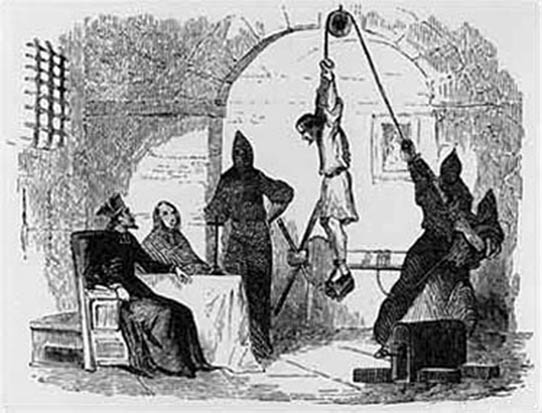
The Inquisition

Popular conception of question time in the Spanish Inquisition / newsbiscuit.com

Popular conception of question time in the Spanish Inquisition / newsbiscuit.com

This was a Catholic tribunal founded on a temporary basis in France and Germany. Its purpose was to seek out heresy, prosecute and punish it. In the thirteenth and later centuries how you decided to worship God in Europe was not optional. Heretics were severely punished, often capitally, by burning alive. The latter is probably the most painful way to die, but the Church believed that only by burning could the non-conformist devil in a person be driven out and destroyed.

   The country of Spain, and later its empire, is chiefly associated by historical novelists with the Inquisition, also known as the ‘Holy Office’ or Santo Oficio. A medieval inquisition was set up in the kingdom of Aragon, with headquarters in Tarragona, but this was superceded in the late fifteenth century by the newly invented Castilian or Spanish Inquisition, founded by a papal bull by Sixtus VI in 1478. The branch was devoted first and foremost to investigating how converted Jews and Muslims were behaving now that they were Christian. The Spanish Jews and Muslims of Castilla had been forced to embrace Christianity in the stern form of Catholic Faith in 1492 and 1502 respectively. (more…)

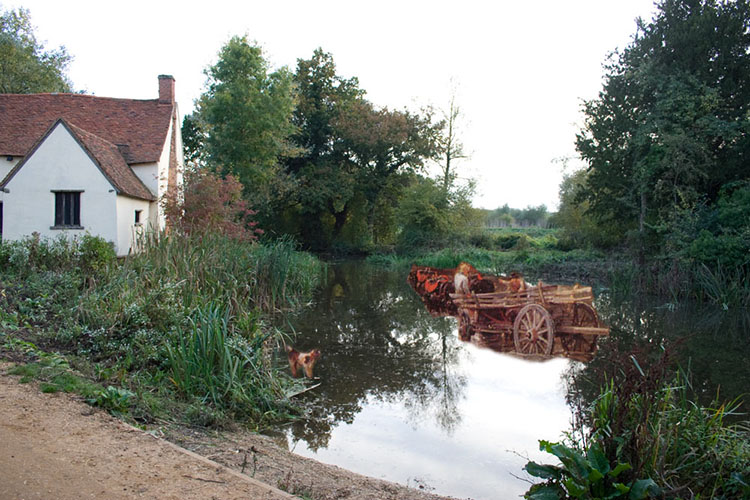
William Cobden

Cobden's ideal England, done by computer / craftform.com

Cobden’s ideal England, done by computer / craftform.com

Cobden was a self-educated farm labourer from Surrey, England who became one of the first professional journalists. By this I mean that he wrote for the papers of the early 19th century for a living, not as a hobby for some ex-graduate. He was born in 1763, and by 1802 he was publishing his own Political Register as an enemy of the French Revolution and supporter of his own government. As such he could be labelled ‘conservative’, but in 1804 he ran foul of the law and was convicted of criticising the government’s conduct of the war against France. The terms ‘freedom of the Press’ or indeed ‘freedom of speech’ had yet to be introduced.

   Personal experience of governmental repression gradually turned Cobden into a radical, blaming ‘misgovernment’ for England’s economic troubles, attacking ‘corruption’ where he thought he saw it, the patronage system, and control of Parliament by the rich and landed aristocracy and gentry fuelled by their own interests. He saw how the poor existed, and defended them as under-privileged. Perhaps he was blind to the tremendous forces which were changing society, because he loathed the factories and the new industrial towns. While Britain grew richer every year, Cobden saw the agricultural worker as an example of a glorious past – growing and tending his crops, breeding fine cattle, feeding often and well from his farm’s produce, weaving his own cloth etc. It was all a dream, but it was Cobden’s dream. (more…)

By | 2014-09-08T10:40:17+00:00 September 8th, 2014|British History, Philosophy|1 Comment
Load More Posts