Dean Swift – Page 20 – General History

admin

Home/Dean Swift

About Dean Swift

‘Dean Swift’ is a pen name: the author has been a soldier; he has worked in sales, TV, the making of films, as a teacher of English and history and a journalist. He is married with three grown-up children. They live in Spain.

The Eighty years War & the Council of Blood

The Duke of Alba / pinternet.net

The Duke of Alba / pinternet.net

Rebellion, protest and actual war were made against Spain from 1568 to 1648, in seventeen of the provinces in the Low Countries (now Holland and Belgium). The so-called Council of Blood actually started in 1567, and was a component part of the troubles.

  The Spanish Hapsburgs ruled these provinces as part of the great Spanish Empire. They had originally been under the influence, if not the mandate, of Burgundy but were at last united by Charles V (Carlos Quinto) who was king of Spain as well as Holy Roman Emperor (q.v.). His son, King Philip II (Felipe Segundo) governed the region through his own appointees the regents, emphasising points of taxation and above all religion. Philip was a devout Catholic,and believed in the persecution of Protestants wherever he found them. (more…)

The Forty-Seven Ronin

Seppuku for the forty-seven / modernimage.com

Seppuku for the forty-seven / modernimage.com

At the beginning of the eighteenth century an incident took place in Japan that rapidly occupied the front pages of world (and worldly) newspapers. Indeed, the happening provided a powerful symbol of self-sacrifice and un-flinching loyalty during generations, even supplying the title of a major Hollywood film; this was Ronin, (1998)I believe the last movie directed by the aged but still brilliant John Frankenheimer. A re-telling of the incident in Japan is spoken during a key scene in the film by the French actor Michael Lonsdale, seated beside a fully equipped model of the castle and surroundings in Japan. (more…)

The French Republican Calendar


The new nomenclature, lavishly illustrated /huberlerch.com

The new nomenclature, lavishly illustrated / hubertlerch.com

During the French Revolution (q.v.) the National Convention decided on a sublimely Gallic act to herald the start of a new epoch for France, and, if popular, for all humanity as well. It would also carry on the process of anti-clericism (burning of churches, slaughter of bishops, priests, monks and nuns etc.), or the organized de-Christianization of France. The old calendar would be swept away. Structures and names were planned by a special committee directed by Deputy d’Eglantine. (more…)

By | 2014-06-27T07:48:22+00:00 June 26th, 2014|French History|2 Comments

The Condor Squadron

/condorsquadron.org

/condorsquadron.org

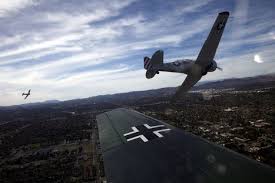
This formed part of Adolf Hitler’s contribution to the Nationalist or rebel side during the Spanish Civil War (q.v.). The pilots came mostly from the German middle and upper classes, and their groundcrew, mechanics etc. were boys from the lower classes doing their military service. For both, flying missions in a foreign country whose government (the Second Spanish Republic) had hardly any aircraft to fight them was more like a youthful adventure than real war. The truth is that the young Germans met virtually no opposition during their lethal visits to bomb and strafe Republican Spanish towns, turning the towns into ruins and killing thousands, mostly civilians. (more…)

What place is this?

In this quiz our readers are asked to name the place that is the subject of certain quotations. You do not have to name the person who made the quote; just use the Comments section on the blog to tell me what place the experts are talking about.

“The people are unreal. The flowers are unreal, they don’t smell.”

“The most important deals . . . are finalized on golf courses or around swimming pools.”

“A city with all the personality of a paper cup.”

“Here you wake up in the morning and listen to the birds coughing in the trees.”

“The most beautiful slave quarters in the world.”

“I worked on Monday and got fired on Wednesday: the guy who hired me was fired on Tuesday.”

“Strip the phony tinsel off . . .and you’ll find the real tinsel underneath.”

“A town where inferior people have a way of making superior people look inferior.”

“An extraordinary kind of temporary place.”

“The only way to be a success in . . .is to be as obnoxious as the next fellow.”

“It provided the kind of luxury that only really exists for the sons of Latin-American dictators.”

“It’s a place where, if you don’t have happiness, you send out for it.”

“Paradise with a lobotomy.”

“ In . . . you can be forgotten if you go out to the lavatory.”

“The only asylum run by the inmates.”

“There’s nothing wrong with the place that six first-class funerals wouldn’t cure.”

And finally, someone who worked there said,

“I went to Scotland and found nothing there that looks like Scotland.”

and that is the clue to the answer to this month’s quiz

By | 2014-06-23T12:38:56+00:00 June 23rd, 2014|World History|0 Comments

A brief history of France

Versailles, a possible cause of the Revolution? / britannica.com

Versailles, a possible cause of the Revolution? / britannica.com

This is one of the oldest established nations in the world, and probably the most individualistic. All Frenchmen are conscious of the superiority of their ancient language, and wearied by foreigners trying – usually failing – to speak it properly. France has enjoyed a hate/love relationship with England for a thousand years, unimproved by several dozen bloody wars, and ever since losing great parts of North America to the British, she has decided that both Canada and the United States are there, but must be ignored.

   France’s antique name was Gallia, and there is evidence of pre-historic settlement, shown by paleolithic carvings and rock painting, for example at Lascaux; there are neolithic megaliths at Carnac, and it is accepted that Celtic-speaking Gauls were dominant there by the fifth century B.C. The Romans added Gaul to the Empire in 125 B.C and in it she stayed, more or less protected, but still a Roman region, until successfully invaded and occupied by Germanic tribes in the third and fifth centuries A.D. The Merovingian epoch started with the domination of the Franks (fifth century A.D.) with Clovis I as king of extensive parts of Gaul. The last of the Merovingians was Dagobert I who died in 638, though the rival dynasty survived until the deposition of Childeric III 113 years later. (more…)

By | 2014-06-24T16:35:08+00:00 June 23rd, 2014|German History|0 Comments

Two failed plots: Babeuf and Cato Street


Babeuf / clairdeluttes.org

Babeuf / clairdeluttes.org


Plotters and plots have been recurrent throughout history. They became famous because of the good fortune that attended them, or the bad luck which dogged them. Queen Cleopatra plotted with her lover Marc Antony to stop Octavian Caesar assuming supreme power in Rome. They failed, both died. His own officers plotted to assassinate King Philip of Macedonia (with or without the help of his wife) and they succeeded in killing the King, but failed to kill his son. They died in battle or by suicide, and Alexander became Great. During the reign of Henry VIII he and his councillors plotted to grab the entire wealth of the Roman Catholic Church in England, and the plot succeeded, while suppression of the ‘Papists’ continued during many reigns, except when the monarch was a Catholic – when Anglicans suffered instead. There was the ‘Babington’ plot to kill Elizabeth I, and the ‘Gunpowder Plot’ to blow up the Houses of Parliament with the new King and all his government with them. They too failed and the plotters paid the full price. A group of powerful aristocrats plotted to remove the annointed, crowned (and unfortunately Catholic) King James II from the throne in the so-called ‘Glorious Revolution’ and they succeeded. No plotter lost his head or his title, and Britain got a Dutch King (William of Orange) who was sensibly Protestant. (more…)

By | 2014-06-20T19:23:41+00:00 June 20th, 2014|British History, French History, World History|0 Comments

Heinrich Brüning

/ es.wikipedia.org

/ es.wikipedia.org

At the age of forty-five he became Foreign Minister and Chancellor of Germany. He was a Roman Catholic member of the Centre Party and became Chancellor during the Great Depression (q.v.). There were three million unemployed in Germany, and Brüning tried to deal with this by deflation, increasing taxation and cutting government expenditure – the classic 3-pointed economists’ dream – which rarely works. (more…)

By | 2014-06-16T08:27:07+00:00 June 16th, 2014|German History, World History|0 Comments

Like to spend the night in a Tudor castle?

West wing at Thornbury / en.wikipedia.org

West wing at Thornbury / en.wikipedia.org

Should you be touring Britain and find yourself in Gloucestershire, you might want to sleep and eat in a genuine Tudor castle at Thornbury, though it is only half-built because its inspirer and builder, 3rd Duke of Buckingham in the Stafford line, was executed before he could finish it; he had intended it to be the finest palace in England.

   Edward Stafford, like the Tudors, descended from Edward III through the Beauforts, as well as Plantagenet prince Thomas of Woodstock. One year after getting his licence to fortify his manor house and enclose a park of around 1000 acres, he evidently wished to build himself a near-regal castle-cum-palace there himself. (more…)

By | 2014-06-13T16:29:13+00:00 June 13th, 2014|English History|0 Comments

Abdication of the Spanish King

Today he becomes King Philip VI of Spain / en.wikipedia.org

Today he becomes King Philip VI of Spain / en.wikipedia.org

Don Juan Carlos was destined by General Franco to become Juan Carlos I, King of Spain, moving aside for political reasons his father, the Count of Barcelona, son of King Alfonso XIII. When Juan Carlos became king cynics called him ‘ElBreve’, or ‘The Brief’ but that was senseless and cruel and inaccurate, because he has just abdicated at the age of seventy-six, after reigning discreetly and well for thirty-nine years. His son The Prince of Asturias, married to the Princess Letizia (they have two fine daughters) will today become Felipe VI.

   Those are the details: but do the Spanish people want a continued monarchy or a third Republic? Some newspapers claim that ‘a huge majority’ of Spaniards prefer a republic. A recently conducted official poll denies this, with a result of less than one percent opting for a republic. We must assume therefore that for official purposes ninety-nine percent of the population wish for a continued monarchy.

   It’s a free country; I do not understand why that one percent should be allowed to cause big trouble – riots, sit-ins, circling the Congress in a menacing manner etc., when all the opponents of monarchy have to do is pack their bags and move into a republic of their own, if they cannot bear the idea of having a king as Head of State. There are two fabulous republics within taxi-ing distance – France and Germany, both with Presidents as Head of State. Why should ninety-nine percent of Spanish people have to put up with the tantrums of a handful of spoiled troublemakers?

   Modern constitutional monarchy means a head of public relations with a crown. The only commitment is to advise ministers. The Queen of Great Britain has managed well enough for more than sixty years. Neither Elizabeth nor Juan Carlos can close Parliament and dismiss the Government, as they once could, even if said government is a sardine can full of corruption. So why the republicanism? Is it in the blood? Were you told by early teachers that kings and queens are not to be tolerated? Are presidents of republics any better? The Second Spanish Republic distinguished itself by giving Russia ALL its gold! A perfect example to follow. Perhaps, if the Spanish monarchy is dissolved by the anarchists they can arrange to give China the whole of Cataluña instead of gold. That would make a wonderful present, and kill two birds with stone, as ‘la inmensa majoría’ of Spanish people are heartily fed up with the continuous machinations of power-mad little men like Art Más y Más who even makes staged entrances to the waiting microphones through double doors opened by flunkeys, as if he were President of the United States instead of a small part of Spain.

By | 2014-06-11T08:51:07+00:00 June 11th, 2014|Spanish History|0 Comments
Load More Posts